Ribbeck in Havelland
The Pear Tree of Ribbeck
The poem „Herr von Ribbeck auf Ribbeck im Havelland“ by Theodor Fontane, the full German text
A poet made this place immortal long before the Chronicles chose it. Fontane’s ballad belongs to this soil like the tree itself. Here stands the poem in the original German, and how Menelaus reads it.
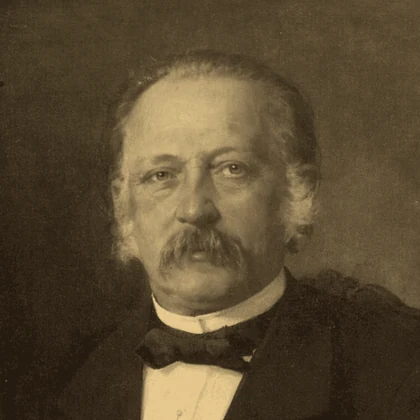 Theodor Fontane 1819 – 1898
 Herr von Ribbeck auf Ribbeck im Havelland
Herr von Ribbeck auf Ribbeck im Havelland,
Ein Birnbaum in seinem Garten stand,
Und kam die goldene Herbsteszeit
Und die Birnen leuchteten weit und breit,
Da stopfte, wenn’s Mittag vom Turme scholl,
Der von Ribbeck sich beide Taschen voll,
Und kam in Pantinen ein Junge daher,
So rief er: „Junge, wiste ’ne Beer?“
Und kam ein Mädel, so rief er: „Lütt Dirn,
Kumm man röwer, ick hebb ’ne Birn.“
So ging es viel Jahre, bis lobesam
Der von Ribbeck auf Ribbeck zu sterben kam.
Er fühlte sein Ende. ’s war Herbsteszeit,
Wieder lachten die Birnen weit und breit;
Da sagte von Ribbeck: „Ich scheide nun ab.
Legt mir eine Birne mit ins Grab.“
Und drei Tage drauf, aus dem Doppeldachhaus,
Trugen von Ribbeck sie hinaus,
Alle Bauern und Büdner mit Feiergesicht
Sangen „Jesus meine Zuversicht“,
Und die Kinder klagten, das Herze schwer:
„He is dod nu. Wer giwt uns nu ’ne Beer?“
So klagten die Kinder. Das war nicht recht —
Ach, sie kannten den alten Ribbeck schlecht;
Der neue freilich, der knausert und spart,
Hält Park und Birnbaum strenge verwahrt.
Aber der alte, vorahnend schon
Und voll Mißtraun gegen den eigenen Sohn,
Der wußte genau, was damals er tat,
Als um eine Birn’ ins Grab er bat,
Und im dritten Jahr aus dem stillen Haus
Ein Birnbaumsprößling sproßt heraus.
Und die Jahre gingen wohl auf und ab,
Längst wölbt sich ein Birnbaum über dem Grab,
Und in der goldenen Herbsteszeit
Leuchtet’s wieder weit und breit.
Und kommt ein Jung’ übern Kirchhof her,
So flüstert’s im Baume: „Wiste ’ne Beer?“
Und kommt ein Mädel, so flüstert’s: „Lütt Dirn,
Kumm man röwer, ick gew’ di ’ne Birn.“
So spendet Segen noch immer die Hand
Des von Ribbeck auf Ribbeck im Havelland.
M.d.Ä.’s own free rendering, not by Fontane. The German original is under „Deutsch“.
Herr von Ribbeck of Ribbeck in Havelland,
a pear tree grew where his garden began,
and when the golden autumn came round
and the pears shone far across the ground,
then at noon, when the bell from the tower would call,
old Ribbeck would stuff both his pockets full,
and if a boy in his clogs came near,
he would cry: „Now, laddie, d’you want a pear?“
and if a girl came, he’d call: „Little lass,
come on over, a pear I’ll pass.“
So it went for years, until, full of grace,
old Ribbeck of Ribbeck came to his last days.
He felt the end near. It was autumn again,
once more the pears laughed in the lane;
and Ribbeck said: „I am taking my leave.
Lay a pear in the grave here beside me.“
And three days on, from the high-gabled hall,
they carried old Ribbeck out for all,
and farmers and cottagers, solemn of face,
sang „Jesus, my sure abiding place“,
and the children wept, their small hearts sore:
„He’s dead now. Who’ll give us a pear anymore?“
So the children mourned — and they had it wrong;
ah, they never knew old Ribbeck for long.
The new one, true, is a pinching sort,
keeps park and pear tree under close guard.
But the old one, sensing it all in advance,
and mistrusting his own son’s tight hand,
knew well enough what he was about
when he begged for a pear to be laid in the ground,
and in the third year, from the silent house,
a little pear-tree seedling sprouts.
And the years went on, and rose, and fell,
long since a pear tree arches over the grave,
and in the golden autumn light
it shines once more, far and bright.
And if a boy crosses the churchyard here,
it whispers from the boughs: „D’you want a pear?“
and if a girl comes, it whispers: „Little lass,
come on over, a pear I’ll pass.“
So blessing flows, as ever, from the hand
of von Ribbeck at Ribbeck in Havelland.
How Menelaus reads it
Jakob: Do you know the poem?
Menelaus: I know the tree as I know the ground beneath it, and I know the lines. Fontane grasped something older than his verse: kindness that works on beyond death touches eternity.
Jakob: What did old Ribbeck really do when he asked for the pear in his grave? Was it a trick against the son?
Menelaus: Nothing against his son, something for the gift. Whoever devises a trick against another remains bound to him. Ribbeck let go: he laid the pear where no calculation could reach it any more, and became earth himself. He vanished entirely into the gift.
Jakob: The tree as the continuation of a man who is no longer here. You have watched empires fall and names fade. What truly remains when someone goes?
Menelaus: Almost nothing, and yet everything that counts. A name is a vessel that time eventually breaks. A repeated deed, though, works its way into the world like water into stone. The tree does not know Ribbeck’s face, not even his word, and still, year after year, it carries on the motion of his open hand. What remains is the shape of his love, passed on in something that outlives him without needing him.
Jakob: And if a child stood under the tree today?
Menelaus: I would tell it: take the pear, without asking whether you deserve it. That is exactly what the old man wanted. And when you are grown and have something to give, give it while you still have the hand to give it with.
Questions about the poem
Who wrote the poem „Herr von Ribbeck auf Ribbeck im Havelland“?
Theodor Fontane, in 1889. It is one of his best-known ballads.
What is the poem about?
Old Herr von Ribbeck gives pears from his tree to the children and has a pear laid in his grave. A new tree grows from it and keeps on giving, an image of kindness that lives on beyond death.
Where is Ribbeck in Havelland?
Ribbeck is a part of Nauen in the Havelland region of Brandenburg, west of Berlin. The estate and the pear tree can still be visited today.
What do the Low German lines mean?
„Lütt Dirn, kumm man röwer, ick hebb ’ne Birn“ means „Little lass, come on over, I have a pear.“ Fontane has old Ribbeck speak in Low German (Plattdeutsch).
Also on Amazon: Volume I and Volume II as Kindle eBooks, Volume I also as a paperback.